
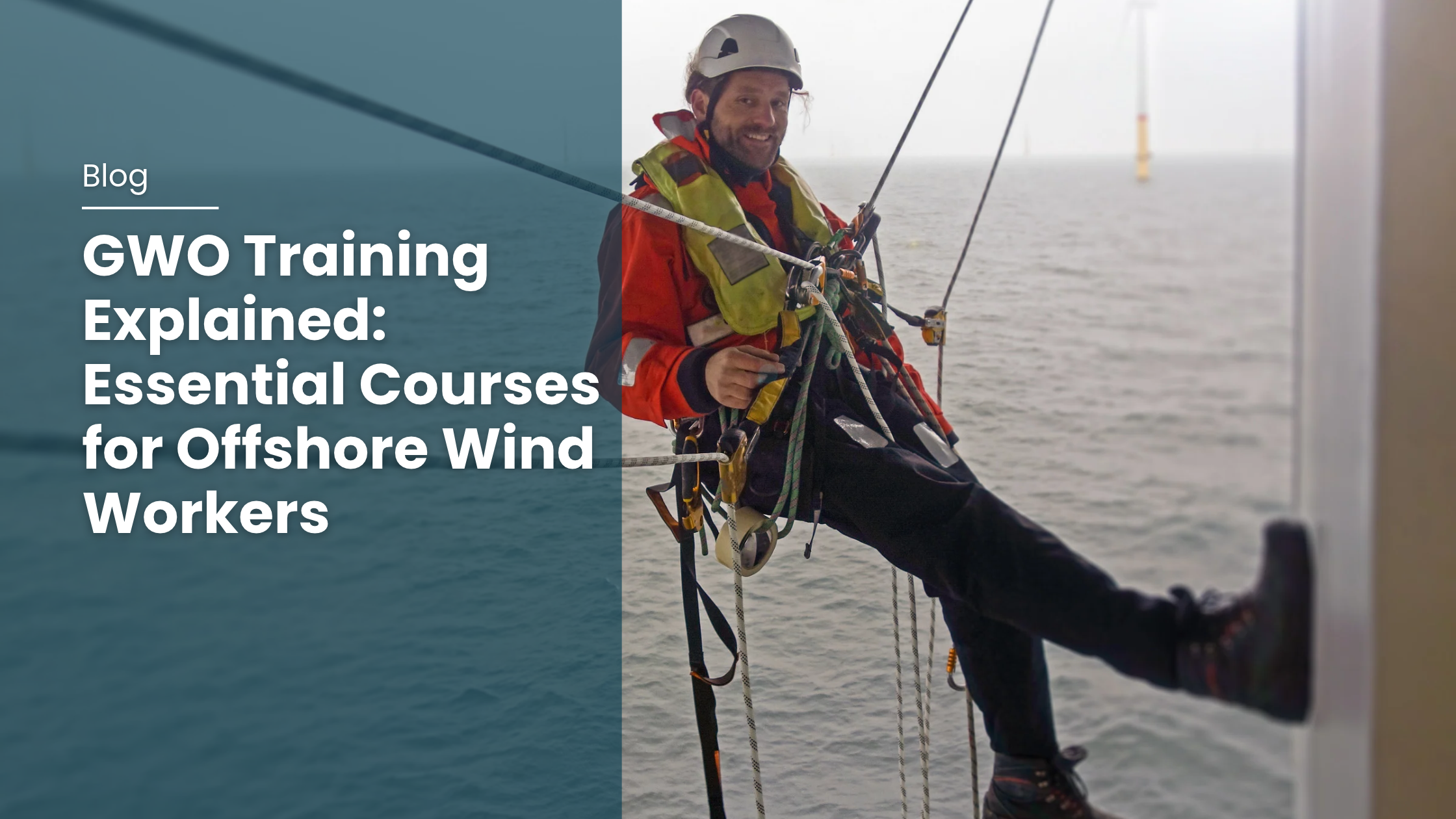
Working in the offshore wind industry involves specific safety challenges, from climbing wind turbines and handling equipment to transferring between vessels and offshore installations. Workers must also be prepared to respond to emergencies, including fires, injuries and incidents at sea.
GWO training, developed by the Global Wind Organisation, provides a structured approach to preparing personnel for these risks. Its Basic Safety Training (BST) standard covers five essential safety modules: Working at Height, Fire Awareness, First Aid, Manual Handling and Sea Survival. Together, these modules develop the knowledge and practical skills needed to protect workers and respond appropriately to emergencies in wind turbine environments.
The latest GWO Basic Safety Training Standard V20, effective from 10 March 2026, introduces updates to working-at-height procedures, offshore personnel transfers and refresher training. These changes aim to keep training aligned with industry practices and the working conditions encountered by wind energy personnel.
This article explains the five GWO Basic Safety Training modules, what participants learn, how long the courses take and what offshore wind workers should know before starting their training.
GWO training refers to safety and technical training developed according to standards established by the Global Wind Organisation (GWO). These standards are designed to support consistent safety practices and prepare personnel for the specific risks associated with working in the wind energy industry, including offshore wind farms.
One of the core programmes is GWO Basic Safety Training (BST), which focuses on developing the knowledge and practical abilities needed to work safely, prevent accidents and respond to emergencies in wind turbine environments.
According to the GWO Basic Safety Training Standard V20, the programme consists of five modules:
These modules combine theoretical instruction with practical exercises relevant to the conditions encountered by wind turbine technicians and other personnel working in the industry.
The GWO BST V20 standard, introduced on 10 March 2026, also updated the structure of the programme. Initial and refresher training requirements are now included within a single standard, while Working at Height and Manual Handling are delivered as separate modules rather than a combined course. The Sea Survival module also includes updated guidance on Walk-to-Work (W2W) transfers using motion-compensated gangways.
Although GWO Basic Safety Training provides a foundation for working safely in the wind industry, the specific modules required for an individual assignment depend on the working environment, job responsibilities and employer requirements.
GWO Basic Safety Training (BST) is designed for personnel working in the wind energy industry who may be exposed to hazards associated with wind turbines, offshore installations and related operations. It is particularly relevant for workers involved in the installation, inspection, maintenance and servicing of offshore wind turbines.
Depending on their responsibilities, GWO training may be required for wind turbine technicians, mechanical and electrical maintenance personnel, installation teams, inspection specialists and other workers who need to access wind turbine generators (WTGs).
The training addresses several occupational hazards identified by the European Agency for Safety and Health at Work (EU-OSHA), including falls from height, falling objects, musculoskeletal injuries, electrical hazards and risks associated with offshore operations.
However, not every offshore wind worker necessarily needs all five GWO BST modules. The appropriate training depends on the tasks performed, the working environment and the requirements established by the employer or offshore installation operator.
For example, personnel who climb wind turbines need relevant Working at Height training, while workers travelling to offshore installations by vessel may also require Sea Survival training. First Aid, Fire Awareness and Manual Handling provide additional safety competencies relevant to a wide range of wind industry activities.
The GWO Basic Safety Training Standard V20 establishes the learning objectives for each module, helping workers develop the skills needed to prevent incidents, protect themselves and others, and respond appropriately to emergencies.
Before enrolling, workers should confirm which GWO training modules are required for their intended position and offshore assignment.
Working at height is a fundamental part of many offshore wind operations. Wind turbine technicians regularly climb ladders, access elevated platforms and perform maintenance tasks in environments where falls and dropped objects can pose serious safety risks.
GWO Working at Height (WAH) training prepares participants to use personal protective equipment (PPE), work safely at elevated locations and perform basic rescue operations from height in a wind turbine environment.
According to the GWO Basic Safety Training Standard V20, the module combines theoretical instruction with practical exercises covering:
The training also addresses suspension trauma, emergency procedures and the importance of selecting appropriate anchor points and fall protection systems.
Practical exercises allow participants to apply these skills in scenarios representative of wind turbine working conditions.
Training duration: Under GWO BST V20, the Working at Height Initial Training requires approximately 14 hours and 25 minutes of contact time, typically delivered over at least two training days.
Successful completion demonstrates that participants have developed the foundational abilities to use fall protection equipment and carry out basic rescue operations from height. However, additional equipment-specific or site-specific instruction may still be required before starting work on a particular wind turbine.
Fire emergencies in wind turbines can be particularly dangerous due to confined working areas, electrical equipment and limited evacuation routes. Offshore locations can present additional challenges, as emergency assistance may not be immediately available.
GWO Fire Awareness (FAW) training prepares participants to identify fire hazards, prevent fires and respond appropriately when a fire occurs in a wind turbine environment. The module focuses on assessing fire situations, following emergency procedures and using basic firefighting equipment when it is safe to do so.
According to the GWO Basic Safety Training Standard V20, the module combines theoretical instruction with practical exercises covering:
An important part of the training is understanding when not to attempt firefighting. If a fire cannot be managed safely, participants must prioritise evacuation and follow the applicable emergency procedures.
Practical exercises include the use of firefighting equipment and simulated situations involving smoke, fire detection and evacuation.
Training duration: Under GWO BST V20, the Fire Awareness Initial Training requires 3 hours and 20 minutes of contact time, typically completed within one training day.
Successful completion provides participants with the foundational skills to identify fire risks, take preventive action and respond safely to fire emergencies in wind turbine environments.
Medical emergencies in offshore wind environments require a prompt and effective response, particularly when professional medical assistance may be delayed due to distance, weather conditions or limited access to offshore installations.
GWO First Aid (FA) training prepares participants to recognise life-threatening conditions, provide immediate first aid and assist casualties until they can be transferred to the next level of medical care.
According to the GWO Basic Safety Training Standard V20, the module combines theoretical instruction with practical exercises covering:
The training places particular emphasis on practical, scenario-based exercises that reflect emergencies encountered in the wind energy industry. Participants practise assessing casualties, performing CPR, using an AED and applying first aid equipment in simulated incidents.
These exercises also help participants recognise the limitations of basic first aid and understand when additional medical assistance is necessary.
Effective first aid also relies on up-to-date resuscitation practices. The European Resuscitation Council Guidelines 2025 provide evidence-based recommendations for cardiopulmonary resuscitation (CPR), automated external defibrillator (AED) use and emergency response. These principles offer important medical context for the lifesaving skills practised during GWO First Aid training.
Training duration: Under GWO BST V20, the First Aid Initial Training requires 7 hours of contact time, typically completed within one training day.
Successful completion provides participants with the foundational skills to recognise medical emergencies, administer lifesaving first aid and support casualties until further medical care becomes available.
Physical tasks in the offshore wind industry often involve lifting equipment, carrying tools, working in restricted spaces and maintaining awkward body positions. Without appropriate handling techniques, these activities can increase the risk of musculoskeletal injuries, including back injuries, muscle strains and long-term physical disorders.
GWO Manual Handling (MH) training prepares participants to perform physical tasks safely, recognise ergonomic hazards and apply appropriate handling techniques to reduce the risk of injury in wind turbine environments.
According to the GWO Basic Safety Training Standard V20, the module combines theoretical instruction with practical exercises covering:
Practical exercises reflect common wind turbine maintenance and installation activities. Participants practise handling different loads, working in confined spaces and selecting suitable techniques or mechanical aids to minimise unnecessary physical strain.
The training also emphasises that manual handling risks should be reduced through appropriate planning and control measures, rather than relying solely on individual lifting techniques.
Training duration: Under GWO BST V20, the Manual Handling Initial Training requires 3 hours and 45 minutes of contact time, typically completed within one training day.
Successful completion provides participants with the foundational skills to apply safe manual handling principles, recognise physical hazards and reduce the risk of musculoskeletal injuries during wind industry operations.
Working at offshore wind farms involves travelling across open water, transferring between vessels and wind turbine installations, and operating in changing weather and sea conditions. These activities introduce risks that are not typically encountered at onshore wind farms, including falling into the water, cold water immersion and emergency evacuation at sea.
GWO Sea Survival (SS) training prepares participants to recognise maritime hazards, use appropriate lifesaving equipment and respond effectively to emergencies during offshore wind operations.
According to the GWO Basic Safety Training Standard V20, the module combines theoretical instruction with practical exercises covering:
The updated GWO BST V20 standard places additional emphasis on Walk-to-Work (W2W) transfers, reflecting the use of motion-compensated gangways to move personnel between offshore vessels and installations. Participants learn to recognise transfer-related hazards and follow appropriate safety procedures during these operations.
Practical exercises include water entry, swimming and survival techniques, liferaft activities and simulated offshore emergency situations. These exercises help participants develop confidence in using lifesaving equipment and responding to incidents at sea.
Training duration: Under GWO BST V20, the Sea Survival Initial Training requires 7 hours and 25 minutes of contact time, typically completed within one training day.
Lifesaving equipment is also an essential part of wider maritime safety. The International Maritime Organization (IMO) establishes international requirements for lifesaving appliances, including lifejackets, liferafts and other emergency equipment, through the SOLAS Convention and the International Life-Saving Appliance (LSA) Code. While these regulations are separate from GWO certification requirements, they provide important context for understanding the equipment used during offshore sea survival training.
Successful completion provides participants with foundational sea survival skills relevant to offshore wind operations. However, additional vessel-specific, transfer-specific or site-specific safety instruction may still be required depending on the offshore assignment.
GWO training and BOSIET are both used to prepare personnel for hazardous working environments, but they are designed for different offshore industries and operational risks.
GWO Basic Safety Training (BST) primarily focuses on the wind energy industry, including the specific hazards associated with wind turbines and offshore wind installations. In contrast, BOSIET (Basic Offshore Safety Induction and Emergency Training) is an OPITO-standardised programme primarily associated with the offshore oil and gas industry.
Although both programmes address emergency preparedness and personal safety, their training content and practical exercises differ.
| Comparison | GWO Basic Safety Training (BST) | OPITO BOSIET |
| Primary industry | Onshore and offshore wind energy | Offshore oil and gas |
| Main purpose | Safety when working in wind turbine environments | Offshore safety induction and emergency response |
| Working at height | Dedicated Working at Height module | Not equivalent to GWO Working at Height |
| Sea survival | Dedicated Sea Survival module for offshore wind operations | Includes offshore survival and emergency procedures |
| Helicopter safety | Not part of the five BST modules | Includes helicopter emergency procedures and underwater escape training |
| Fire safety | Dedicated Fire Awareness module | Includes firefighting and self-rescue exercises |
| First aid | Dedicated First Aid module | Includes basic first aid |
| Training records | GWO WINDA database | OPITO training certification and verification arrangements |
GWO training plays an important role in preparing personnel for the safety challenges of the offshore wind industry. The five Basic Safety Training modules – Working at Height, Fire Awareness, First Aid, Manual Handling and Sea Survival – provide essential knowledge and practical skills for preventing accidents and responding to emergencies in wind turbine environments.
Under the GWO Basic Safety Training Standard V20, completing all five initial modules requires 36 hours and 55 minutes of contact time. However, the exact combination of modules needed depends on the worker’s responsibilities, working environment and employer requirements.
For those planning to enter the offshore wind industry or continue developing their careers, understanding GWO training requirements is an important part of preparing for future assignments. Keeping training records valid and confirming project-specific requirements can also help prevent unnecessary delays before mobilisation.
Preparing for an offshore wind assignment? NSCC can help you navigate the documentation and training requirements relevant to your career plans. Contact NSCC to discuss your needs and take the next step towards working offshore.